Many organizations invest heavily in detection, analytics, dashboards, and centralized monitoring.
Yet RBQM still stalls.
The reason is not lack of insight.
It is lack of structure between insight and action.
Detection alone does not sustain oversight.
Insight alone does not create consistency.
RBQM becomes difficult to maintain when there is no defined way to translate signals into proportionate, documented decisions.
When Detection Outpaces Decision-Making
RBQM stalls when:
-
Signals are identified but not clearly prioritized
-
Ownership for review is unclear
-
Actions are inconsistently documented
-
Oversight decisions vary by study or function
Teams remain busy.
Dashboards remain active.
But oversight becomes fragmented.
Over time, this fragmentation makes RBQM harder to scale, and harder to defend.
RBQM Requires an Operating Loop
Effective RBQM defines:
-
Who reviews which signals
-
How prioritization decisions are made
-
What actions are expected, and by when
-
How outcomes are documented and reviewed
Without this structure, programs rely on individual interpretation rather than shared logic.
With it, oversight becomes consistent, proportionate, and repeatable.
Modern RBQM operates as a continuous loop, connecting what matters (CtQs), what is detected (signals), what is prioritized, and what is done.
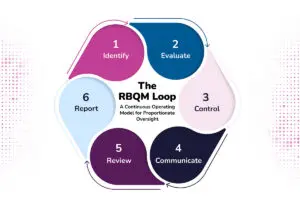
This operating loop is what allows RBQM to scale across studies and portfolios and remain inspection-ready.
When the loop is intact:
-
Decisions are made proportionately
-
Ownership is clear
-
Actions are consistent
-
Rationale is traceable
RBQM stops being a series of isolated activities and becomes a sustained oversight model.