Most sponsors and CROs are now fluent in the language of Risk-Based Quality Management (RBQM). Terms like Quality by Design, Critical-to-Quality factors (CtQs), KRIs, QTLs, and centralized monitoring are widely understood.
And yet, many organizations still feel unprepared.
Not because they don’t understand the guidance, but because RBQM has evolved faster than the way trials actually operate.
RBQM Didn’t Just Change on Paper
Over the past decade, regulators have steadily pushed the industry away from uniform oversight and toward proportionate, risk-based approaches. At the same time, clinical trials have become more complex:
- More endpoints and procedures
- More countries, vendors, and systems
- More continuous and near–real-time data
- Traditional quality practices, built for simpler trials, no longer scale in this environment.
Modern RBQM emerged not as a compliance exercise, but as an operating discipline, a way to focus oversight on what truly matters to participant safety and data integrity.
The Real Readiness Gap
Today’s RBQM challenges are rarely about intent or awareness. They are about execution.
Common symptoms include:
- RBQM frameworks that exist but don’t guide day-to-day decisions
- Centralized monitoring outputs that don’t clearly translate into action
- Difficulty explaining oversight choices during inspections
In these cases, RBQM exists, but it isn’t fully operational.
What “Regulatory-Grade RBQM” Actually Means
Modern, regulatory-grade RBQM is defined less by tools and more by how decisions are made, documented, and reviewed.
It connects:
- What matters (CtQs)
- What is detected (signals)
- What is prioritized (oversight focus)
- What is done (actions and outcomes)
This is the shift organizations must make to be truly ready under ICH E6(R3).
Ready to Operationalize Regulatory-Grade RBQM?
Understanding the shift is only the first step.
Operationalizing it across study, site, and portfolio is what defines true readiness under ICH E6(R3).
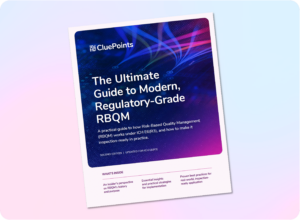
Explore the Practical Guide to Modern, Regulatory-Grade RBQM
A comprehensive framework connecting CtQs, signal detection, prioritization, and action into a living, inspection-ready oversight model.